Ranking changes
Did important queries, pages or page ownership change in a way that explains the traffic movement? If ranking loss is confirmed, investigate the Google Ranking Drop.
Interweb Media · Organic traffic investigation
Organic traffic decline is a symptom, not a diagnosis. Interweb investigates the evidence to establish what changed before remediation begins.
No promise of recovery. A clearer account of what was lost, where it concentrated and what should happen next.
Traffic loss is a symptom
Organic search traffic can fall for different reasons, and more than one condition can overlap. The first task is to establish whether the change is real, when it began, which search surfaces moved and which parts of the website were affected.
Interweb does not begin by assuming a technical issue, an algorithm update, a content problem or a penalty. It begins by narrowing the evidence.
Diagnostic directions
These are possible lines of investigation, not a checklist that every traffic decline must pass through. The work follows the shape of the loss.
Did important queries, pages or page ownership change in a way that explains the traffic movement? If ranking loss is confirmed, investigate the Google Ranking Drop.
Is there evidence of changed access, indexation, redirects, canonicals, rendering or other technical constraints?
Did a release, redesign, template change, content edit or structural decision alter the search journey? If the change was a redesign, investigate what changed after the redesign. If it was a migration, see the SEO Migration Audit.
Did the audience, season, market or query demand shift independently of the website?
Did result features, intent, devices or the competitive shape of the search page change?
Did competing pages or businesses change the context in which the affected pages are evaluated?
Is the reported decline consistent across analytics, Search Console and the underlying collection setup?
Build the timeline
A useful investigation reconstructs the period before and after the change. It compares the first movement with releases, content changes, search demand, ranking signals, competitor movement and measurement conditions.
The aim is to reduce coincidence and identify the sequence that deserves closer testing.
Find where the loss is concentrated
Compare affected and unaffected pages, query groups, templates, directories, markets, devices and search surfaces. A site-wide impression is not the same as a site-wide cause.
Grouping the loss makes it possible to test a specific explanation rather than react to an aggregate number.
Evidence into diagnosis
Once the affected area and timeline are clear, the evidence can be tested against the most plausible causes. Some investigations point toward technical constraints. Others point toward demand, search result behaviour, site changes, competitors or measurement.
If the evidence becomes specifically technical, the next step may be a Technical SEO Audit. A traffic drop does not automatically require one.
Forensic deliverable
The output is a working decision record, not a recovery promise. It explains the evidence, the strongest diagnosis available, the uncertainty that remains and what should happen next.
What changed, measured against the right baseline and search surface.
Which pages, queries, templates, markets or devices carry the signal.
What the evidence supports, what it rules out and where confidence is limited.
The most useful next action and the evidence required to verify it.
Remediation follows diagnosis
Traffic loss creates pressure to act quickly. The wrong action can add noise, introduce risk or consume time without addressing the condition that changed. Diagnosis creates the basis for choosing whether the next step is technical repair, content or structural work, measurement correction, further investigation or no immediate website change.
See how investigation connects to implementation and verification →
Evidence infrastructure
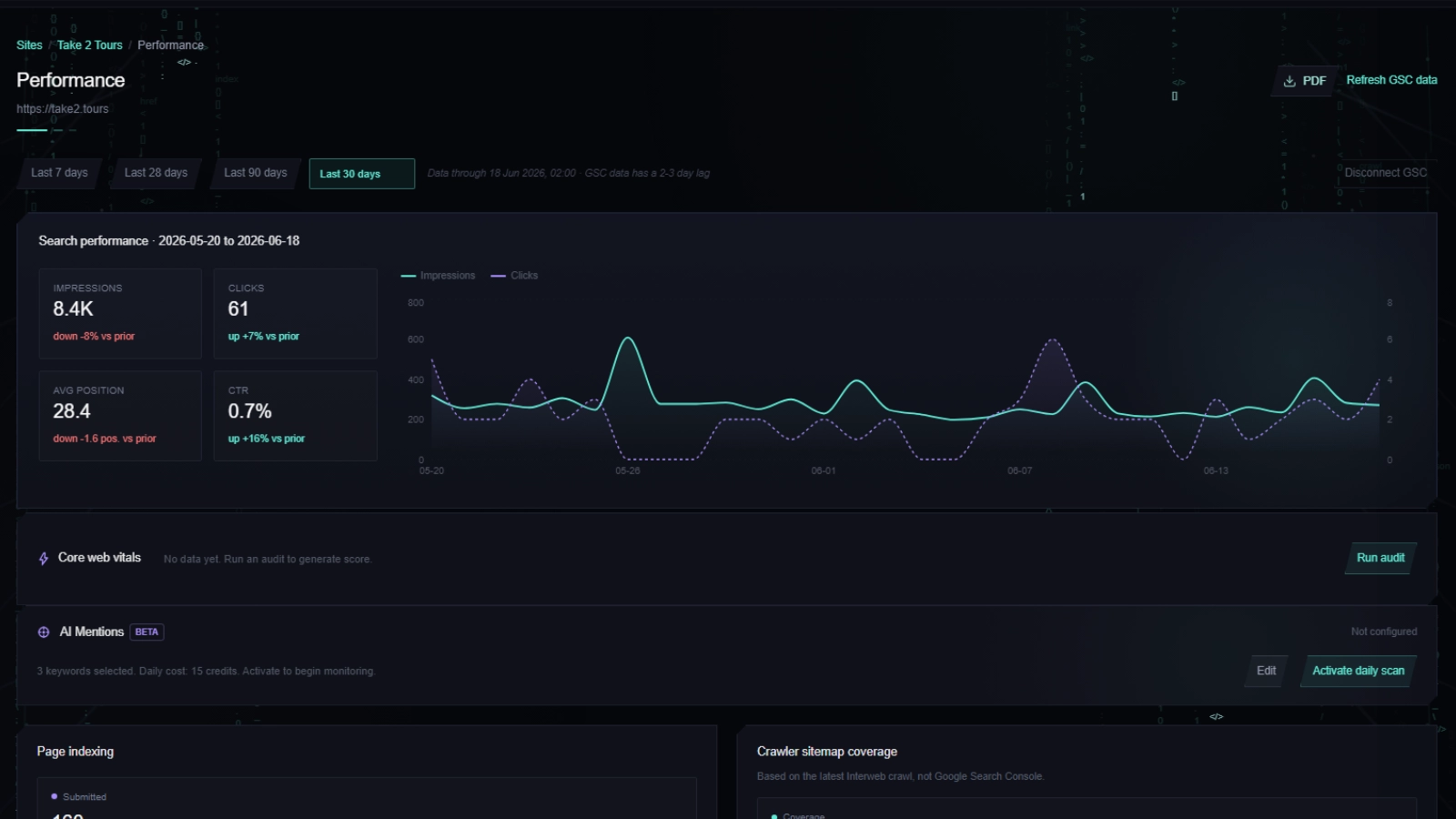
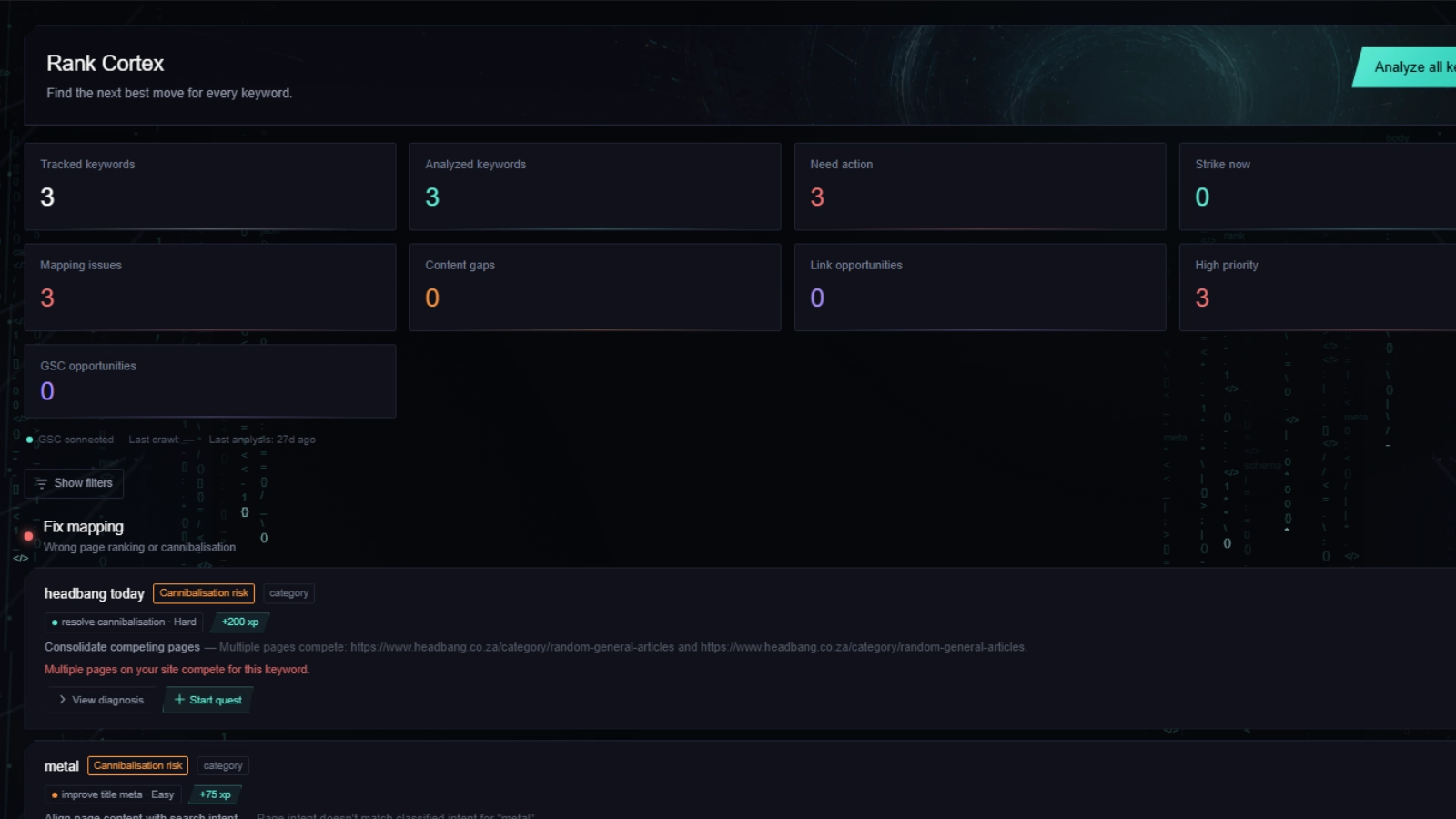
Search performance, ranking context, crawl evidence, affected page groups and implementation history can stay connected to the question that started the investigation.
Start with the evidence
Begin with the website and the change you have observed. The public diagnostic journey is the starting point for establishing what happened and what should happen next.